Dear Game Developers: Stop Using Greek as Decoration
An Open Letter to the Game Industry
To the creative directors, narrative designers, localization teams, and marketing departments of the global gaming industry:
We need to have a conversation about something that has been bothering Greek gamers for quite some time.
Please stop using Greek words as game titles when the actual game has little or nothing to do with what those words mean.

And before anyone misunderstands what I am saying: this is not a demand that you stop using Greek.
Quite the opposite.
Greek is an extraordinarily rich language. It has an enormous vocabulary, a history stretching back more than three millennia, and it is still spoken, written, taught, argued over, cursed in, joked in, and used on the internet every single day.
We are still here.
We are not statues in a museum. We are not characters from Assassin’s Creed Odyssey. We are not all sitting around dressed like philosophers waiting for the next Hollywood production to discover Zeus again.
We are online. We play your games. We read your titles.
And sometimes we see what you have called your game and think:
“What the hell does that even mean?”
Not because we don’t understand Greek.
Because you have taken a Greek word, removed it from its linguistic context, turned it into an exotic-looking brand name, and then expected us to regard it as mysterious or profound.
To a native Greek speaker, it often isn’t mysterious.
Sometimes it is just ridiculous.
Greek Is Not an Ancient Language Sitting in a Display Case
There seems to be a persistent idea in Western entertainment that Greek is primarily a source of cool-sounding ancient words.
Open a dictionary.
Find something that looks sufficiently philosophical.
Put it in uppercase letters.
Congratulations: you have a sophisticated game title.
Except there is a problem.
The people who speak Greek today also have dictionaries.
We know what these words mean.
We know how they are normally used.
We know when something sounds natural, when something sounds archaic, and when something sounds like somebody threw random Greek syllables into a corporate naming meeting.
And that matters.
When an English-speaking player sees a word that resembles Greek, they may experience it as exotic, mysterious or intellectual.
When a Greek player sees the same word, they may simply see an ordinary word from their own language.
That changes the experience completely.
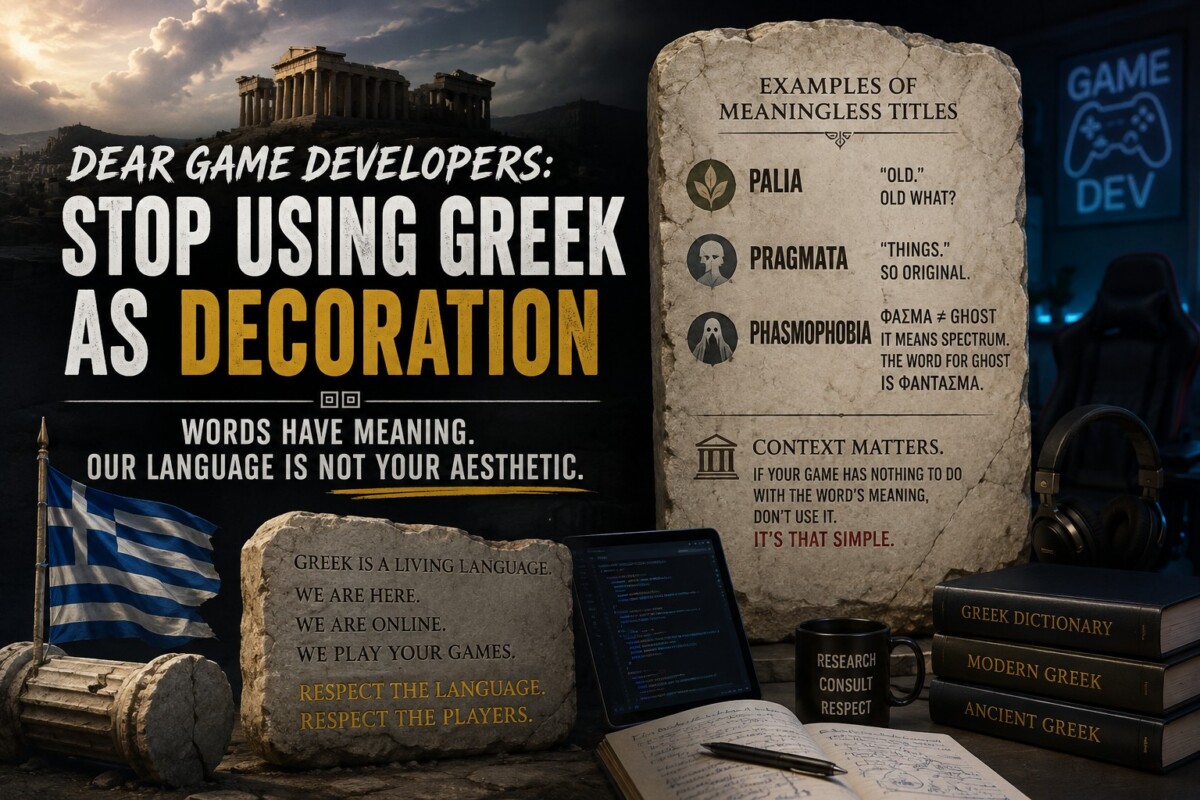
Let’s Talk About Palia
Take Palia.
The developers have explained that the name is derived from Greek for “old,” referring to the deep history of the game’s world. (Palia Support)
Fine.
I understand the intention.
But intention does not magically change what a word communicates.
A Greek player sees:
Παλιά.
And immediately thinks:
Old.
Old what?
The player character?
No. The game explicitly describes the player character as a young adult. (Palia Support)
The houses?
Not particularly.
The lifestyle?
No.
The game itself?
It is a modern-ish, cozy, colorful life-simulation MMO.
And yes, there is an ancient history buried underneath the world. The developers have clearly established that humans disappeared thousands of years ago and that the game’s lore revolves partly around discovering what happened in the distant past. (Palia Support)
But that does not mean “Palia” communicates that information.
A Greek person who encounters the title without knowing the lore doesn’t receive:
“Ah, this must refer to the ancient history of this civilization.”
They receive:
“Old.”
And then they have to reverse-engineer the developer’s explanation afterwards.
That is precisely my problem.
A title should not require the developer to publish an FAQ explaining why the word they chose supposedly makes sense.
And Then There Is PRAGMATA
PRAGMATA is another fascinating example.
The Greek word πράγματα means “things,” “matters,” “affairs,” and related concepts.
Again, there is nothing inherently wrong with the word.
It is a perfectly real Greek word.
But when a Greek gamer sees:
PRAGMATA
the immediate reaction is essentially:
“Things.”
Things.
What things?
Why?
What does that tell me about this game?
Capcom’s actual game is a science-fiction action adventure set in a near-future lunar world involving Hugh, an android named Diana, artificial intelligence, hacking, and a mysterious research station. (Capcom)
You can potentially build an elaborate philosophical interpretation around “things,” objects, humanity, artificial intelligence and material existence.
Perhaps there is one.
But that does not change the immediate linguistic experience of the title.
Imagine an American studio releasing a massive AAA science-fiction game called:
STUFF
And when somebody asks why it is called Stuff, the developers respond:
“Because the game explores the philosophical relationship between objects, identity and consciousness.”
You might admire the explanation.
You would still ask:
“Yeah, but why did you call the game Stuff?”
That is how PRAGMATA sounds to a Greek.
And this is the fundamental problem.
The Phasmophobia Problem
This is where the distinction becomes even more important.
Phasmophobia is a game about ghosts.
The developers chose a term constructed from Greek roots to express the fear of ghosts.
From the perspective of English-language terminology, this makes perfect sense.
But Greek is not simply a bag of Ancient Greek roots that happens to be sitting underneath modern English.
Modern Greek is a living language.
And in modern Greek, the ordinary word for a ghost is:
φάντασμα — fántasma
The modern Greek dictionary explicitly defines φάντασμα as a supernatural or ghostly being. (Greek Language Portal)
Meanwhile, φάσμα — fásma is a different word, with modern meanings including a spectrum or range.
So when a Greek person sees:
PHASMOPHOBIA
we don’t naturally read it as:
“Fear of ghosts.”
We are much more likely to recognize φάσμα as its own modern word.
Of course, the promotional artwork tells us what the game is about.
But that is precisely the problem.
The image explains the title instead of the title explaining itself.
You have taken an ancient Greek linguistic root, turned it into a modern English construction, and created something that works perfectly well for English terminology but does not correspond naturally to the modern Greek vocabulary from which it supposedly comes.
And no, I don’t care that English-speaking academia has historically used Greek roots in a particular way.
Greeks speak Greek.
We don’t have to pretend that the way an English medical term was constructed centuries ago is identical to the way the corresponding words function in our language today.
That is an important distinction.
Greek-derived English terminology is not automatically Modern Greek.
We Are Not Asking You to Stop
This is the part I want game developers to understand.
I am not saying:
“Don’t use Greek words.”
Please use them.
Our language is rich enough to give you thousands of possibilities.
But use them properly.
If your game is about Greek mythology, use Greek mythology.
If your game is about Greek history, use Greek history.
If your game revolves around a philosophical concept, find the Greek word that actually describes that concept.
If your protagonist represents memory, fate, death, time, identity, hubris, catharsis, tragedy, rebirth or whatever your narrative is actually exploring, there are Greek words for all of these concepts.
And there are usually several ways to express them depending on exactly what you mean.
That is the beauty of the language.
But don’t open a dictionary, find something that looks cool in Latin characters, and then slap it on the box because it sounds vaguely philosophical.
Context Matters
Imagine making a game called:
and then setting the entire game inside a Soviet gulag.
You could come up with a 900-word developer blog explaining how “pastitsio represents the layered nature of trauma.”
I would still look at the title and say:
What the fuck does pastitsio have to do with this?
That is the problem.
The title and the content should have a relationship.
It doesn’t have to be literal.
It can be symbolic.
It can be metaphorical.
It can be obscure.
It can even be deliberately misleading.
But there should be a reason.
If I am going to discover that reason only after reading an interview with the creative director five years later, perhaps the word wasn’t doing a particularly good job as the title in the first place.
Imagine Doing This With Other Languages
And before someone says:
“Why are you only complaining about Greek?”
I’m not.
I’d make exactly the same argument about any living language.
Imagine taking a Japanese word, misunderstanding its contemporary meaning, using it as the title of an unrelated American game, and then telling Japanese players:
“Well, technically, we found this definition in an old dictionary.”
Why should that be acceptable?
Imagine doing the same thing with German, Arabic, Spanish, French, Korean or Hindi.
A living language belongs to the people who actually speak it.
That doesn’t mean outsiders aren’t allowed to use it.
It means that using it comes with the responsibility of understanding what you are using.
Ask a Native Speaker
This is also the simplest part of all.
You have the budget.
You have writers.
You have localization departments.
You have historical consultants.
You have lawyers checking trademarks.
You have entire teams dedicated to making sure that a character’s armor has the correct number of bolts.
You can afford to ask a native speaker:
“Does this word actually make sense?”
And not just:
“Is this technically a Greek word?”
Those are two completely different questions.
Ask:
What does this mean in Modern Greek?
Does it sound natural?
What does a Greek person immediately think when they see it by itself?
Does this title actually describe, symbolize or connect to anything in the game?
Does this word have another meaning today that makes our title sound ridiculous?
That consultation might take an hour.
It could save you from giving an entire game a title that makes half the Greek-speaking audience wonder whether your marketing department owns a dictionary.
Greek Is Capable of So Much More
And this is the ironic part.
You don’t have to dumb Greek down into one exotic-looking word.
Greek is extraordinarily expressive.
You can use compounds.
You can use phrases.
You can use ancient terminology when the historical context calls for it.
You can use modern Greek when the contemporary context calls for it.
You can use philosophical terminology.
You can use poetry.
You can use mythology.
You can use ordinary everyday language.
You can construct a title that actually says something.
Please do that.
Don’t use Greek because Greek “sounds cool.”
Use Greek because Greek says exactly what you want to say.
There is a huge difference.
To the Game Developers Reading This
The next time you decide that your game needs a Greek name, don’t ask:
“What Greek word sounds badass?”
Ask:
“What am I actually trying to say?”
Then find the Greek word or phrase that says it.
And if the proper word is too ordinary?
Good.
Maybe ordinary is exactly what you need.
If the proper Greek title contains two, three or four words?
So what?
You don’t get extra points for making a Greek title look like an ancient spell.
Our language does not need to be mysterious to be interesting.
It is already interesting.
It has survived thousands of years, evolved continuously, and is still being spoken by real human beings who are sitting at home, opening Steam, watching Twitch, reading Reddit, browsing YouTube and buying the games you make.
We are your audience too.
So when you put a Greek word on your game’s cover, remember something very simple:
A Greek person is going to read it.
And we might not see the mystical, sophisticated, exotic title you imagined.
We might just see:
“Old.”
Or:
“Things.”
Or:
“Spectrum.”
And then we will look at your game and ask:
“What exactly does that have to do with this?”
So please, game developers:
Use our language.
Use it creatively.
Use it beautifully.
But for the love of Zeus, use the right fucking words.